Saturday, January 2, 2016

Transparent

A friend who read one of my  earlier blog posts about transgender novels recommended me Casey Plett’s excellent article about transgender fiction, The Rise of the Gender Novel in The Walrus.  Plett argues that transgender characters in contemporary fiction (such as Shani Mootoo’s Moving Forward Sideways like a Crab, Kim Fu’s For Today I Am a Boy, and Kathleen Winter’s Annabel) are written like tortured heroes and lack the dynamics of full characters. Their transgender story takes over the novel at the risk of other elements. Plett clearly has issue with transgender stories written by cis-gender authors, and I get this. Can cis-gender people really understand the trans experience? I'm not sure. However, the books that I really loved from my original list of transgender reading were written by trans people: Ivan E Coyote and Rae Spoon’s Gender Failure and Kate Bornstein’s A Queer and Pleasant Danger.
 

So why am I thinking about this again? Well, a few years ago at a writing festival a student from the audience asked the panel I was hosting if any of the authors would write a transgender novel. The panel all agreed they felt ill-equipped to write a trans story, but I was intrigued. (My mind instantly went: Jewish trans person!) The student clearly had a desire to be represented in a book, and hadn’t yet had this experience. I started reading about the trans community with the thought or eventually writing a trans character.
 

All this was before Orange is the New Black and before Kaitlyn Jenner came out and before my own students started asking me questions about trans people. I’m hoping the trans community will fill the YA book world with diverse books about the trans experience the way they are filling the media world, and I can stick to things I know.     


In the mean time I’m become obsessed with the Amazon show Transparent. I don’t often binge-watch a series, but my brother recommended this show to me. He said, “You’re going to wish you wrote it.” And he’s right. Transparent is the stuff of my writing dreams: a show about a Jewish family delving into their queerness. Mort Pfefferman is the trans-parent who reveals himself to his children as Maura, a woman. Yet the show goes way beyond any YA coming-out tropes. All three adult Pfefferman children cope with their father becoming a mother (from Poppa to Moppa) differently, but it isn’t his queerness or gender
Jeffrey Tambour as Maura
transition they care about. The Pfeffermans are too selfish for that kind of questioning. Sarah Pfefferman discovers her father dressed as a woman while starting a lesbian affair in her father’s bedroom, and her own sexual journey will always be more important than her fathers. Similarly, the youngest
Pfefferman, Allie, uses her father’s transition to continue her own sexual adventure where queerness isn’t an issue but a landscape to be explored. When Josh Pfefferman does mourn the loss of his father in the final episode of Season Two, (with a rescued duck floating in the bathtub behind him), his grief is so long in coming it feels fresh and unexpected.


Carrie Brownstein and Gaby Hoffman as Allie and Sid

Not only is Transgender beautifully written and filmed,  it portrays a Jewish family in a way I found irresistibly familiar and outrageously dysfunctional. These people are my people-they celebrate the same holidays, talk the way my relatives speak, intermarry the way my community does, and are shadowed by the Holocaust in a familiar way. At first I wasn’t sure about the Holocaust references, but I think the writers are saying something more interesting than the usual concentration camp history. Their linking of the suffering of transgender people by the Nazis with current transgender stories feels new and ususual. 


I can’t wait for Season Three. I'm hoping Angelica Houston will be in it, and Didi Conn (Frenchie from Grease) and Carrie Brownstein (from Sleater-Kinney and also Portlandia).  I hope Jeffrey Tambour as Maura will continue to be as compelling an actor and character, and I long for more scenes with Judith Light (from Who's the Boss) who plays the Pfefferman's mother, a character both meshugannah and familiar.

Monday, November 2, 2015

Finding The Narrow Point

November is National Novel Writing Month. Although I've never participated in the NaNoRiMo, I think about it every year, and it spurs on my writing in some way. NaNoRiMo, (short for National Novel Writing Month) flies in the face that it takes years to write in a novel. Instead, they believe a novel can be written in the thirty days of November. Valuing "enthusiasm, determination, and a deadline," NaNoRiMo isn't necessarily about quality writing, but about getting the deed done. Nowhere on the website does it say your novel has to be good, it just needs to get written. And really, sometimes when I'm working on a first draft, I'm just trying to get something, (anything!) down on paper.


 Although I won't be participated in NaNoRiMo this year-it sounds like a great way to develop carpal tunnel syndrome- I will be attempting to plunge deep into a novel I've been hovering around for all too long. (And perhaps I will be indulge in a little NaNoRiMo pep-talk reading. Who can resist a topic like, Five Steps to Building a Propulsive Story Cannon?) I think I've finally narrowed in on what the book is going to be about. Prior to this, the novel stretched out over 110 years in the life of one person. Really, you say, isn’t that impossible? Why, yes it is. I wanted the book to include Victorian factories, women travelers, rural childhoods, sister rivalry, fifty years of Indian history, World War 1 and 2, Indian Independence and separation, and British people staying on in India- just to name a few. When I envisioned the book, I saw not just stories, but lives scrolling ahead of me. I had so much rich research in my head (and computer), that I wanted to put it all in. Not only would this make a very big book, it would also be very thinly spread. I’m sure there are other writers who could write a rich book with such a great breadth, but I when I thought about it closely, I realized what I really knew about was Victorian women travelers and governesses.


Knowing deeply about one small part of the book was a very good thing. This helped me find what I call the Narrow Point. This is a small or pointed wedge that finally dives into the novel. Instead of traveling wide and thin, I now had a narrow groove to go deeply into my characters and their lives, and write a book that will be character driven, as opposed to a rollicking and-then-this-happened kind of book. (Those kids of books are great too, it’s just not what I wanted my book to be.)


Getting to this narrow point isn’t always easy, and sometimes I’m not sure how to get there. Mostly a great deal of thinking and mulling over occurs and just when I’m about to give up, I find I know how to start. Usually I find walking (or sometimes swimming or biking) helps too The past couple of summers I’ve found my narrow point by walking behind my cottage. Throughout the school year I sit at my desk and write on a morning schedule. During that time I don’t look at email or answer the phone, I just write. When summer comes my schedule falls apart. I travel, play with my kids and visit family in July. In August there are guests to hang out with and canoes, bicycles, swimming and yoga to distract me. I don't have a desk to work at, so I spend a lot of time walking up and down the hills behind my cottage and thinking about intractable writing-related problems. I talk to myself a lot on the old hill, running through all the novel's possible options. Should I start at the beginning of my character’s life? Should it begin with the death of the character’s protector? Is the book going to focus on her marriage, or what about the end of her marriage? Should I just start at the beginning and work my way through? What is the beginning story for this character? I re-read the hundreds of pages of notes I have and look through my research notes. Nothing is clear at first. Sometimes it takes days, other times months. And then I see where the story has to start, what the confines of the plot have to be, and a great sense of relief comes over me. Working within set limits and narrow areas of plot makes the writing come easier. Then I can can come up with a list of scenes to write, the kind of writing that works well on a set time frame at a desk during the winter months of writing concentration.

Thursday, October 1, 2015

Mapping your Novel


My new YA book, Feast, is almost ready to go to my editor, Sarah. This is a good place to be! I’ve done the frantic early writing where my ideas feel fresh and new, and the long walks up and down the hill behind my cottage when I can’t envision how it will all fit together. I’m past the stage where I have to force myself to write scenes and new dialogue. I’m even past the stage where I’m reading the manuscript to eradicate unhelpful words like “really” “very” and “something.” The book feels complete, like it’s a story I’d be happy to show others. I’m sure Sarah will point out weaknesses I didn’t see, and I’ll have more work to do this winter, but for now I feel satisfied.

Novel Map for Feast

One of my final steps is to make sure all the various plot lines are developed logically. This involves a lot of jumping around in the text to find different scenes and read them sequentially. Most of the time my book feels bigger than my head and I can’t hold all the parts inside it and see if it progresses in a logical order. That’s when the writing program Scrivener is amazing. You can corkboard your scenes and then flip back to your outline easily. I used to do this on giant sheets of thin paper over my desk, with colour-coded scenes. I recently took down some of these posters, one for a book I won’t write, another for a long finished project. The wall is very blank now.


Somehow, my Scrivener scene list felt like not enough. When I merged my book into a Word document, I stopped updating my Scrivener Corkboard and was without a map to the book. I missed my giant wall posters. So, I decided to create one by hand for Feast. This was a great way to reacquaint me with a book I’ve taken a break from for the summer, and also allowed me to see where there were holes in my story development. And somehow, it was easier to have old-fashioned hand written notes to refer back to.

Friday, September 25, 2015

Bottle and Glass


I'm going to a book launch party for my friend, neighbor and fellow author, Morgan Wade tonight. Morgan has published in various journals and anthologies and tonight he'll be launching his second book, Bottle and Glass.  He's asked me to introduce him, which is a great honour.

I’ve already had the good fortune to read the meticulously researched and moving Bottle and Glass. The novel tells the story of two young English fishermen forced into service with the Royal Navy towards the end of the war of 1812. The two young men, stationed in Kingston, spend most of the novel trying to escape the military and return home. Many of the scenes in the novel take place in historic Kingston places, especially taverns. This  is because according to Morgan much of life in Upper Canada took place in inns and taverns. Apparently in 1812 there were a whopping 78 taverns in Kingston. The novel's title, Bottle and Glass is from one such notorious tavern, "Violin Bottle and Glass."


When I was reading the novel, my mind kept imagining an earlier Kingston. It made me think of Anne Fadiman’s essay from her collection Ex Libris, called You Are There. She describes the magical feeling of reading a book in the place it describes or is set in. For example, you go to Greece, you read Homer. In New York you read Salinger or Joseph O’Neil. When reading Morgan’s book, I had the sense of It Used To Be Like That Here. I could so clearly see the landscape I know, both as it was then, and it is now.


Not only does Morgan knows a few things about early Kingston, he also knows a lot pubs and drinks. I consider him my personal bar tender. He mixes a  mean Martini, he’s generous with his Scotch and he's always willing to make my personal drink of choice, a White Lady. He’s also a great neighbor and a wonderful friend.


Morgan's launch is tonight: Friday, September 25th, 9:30pm at the Queen's Inn, Kingston, ON.


Saturday, September 12, 2015

Happy New Year or Some Thoughts on Teaching Hebrew School

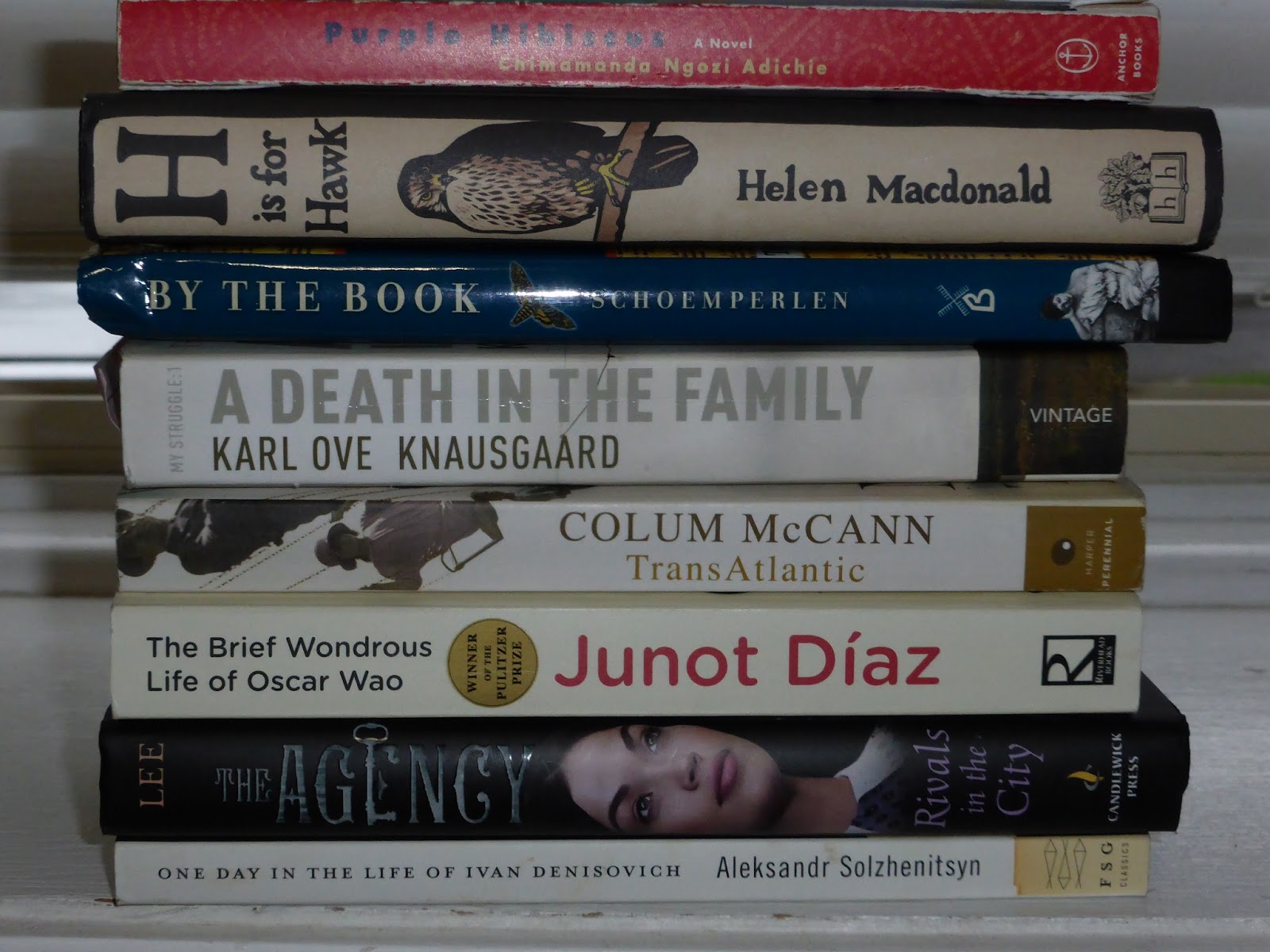
My August reading pile. I also read and loved Americanah by
Chichimande Ngozi Adache, which was too good to keep to
myself and is on loan to a friend.

Forget books for a minute. Wait, I know you're thinking, isn't this a book blog? Well, it is mostly. Except I'm too busy to read much in September. I spent all of August saturated in good books. (If  you want to see what I've been reading, check out the photo at the side.) But now, it's September and I don't have much time for reading. Keeping up with my New Yorker subscription will be enough for a few weeks.


You see, September is about work for me. I just completed my first week of teaching, both at the elementary school where I teach French (and apparently Health and Music too this year) and at the Reform Hebrew school program I run for a small group of children, including my own sons. A friend pointed out that I'm teaching six days a week right now, as well as writing books. That's a lot of classroom time! I have to admit Hebrew school stresses me out. I'm always searching for a good craft, or wondering if I've got the curriculum right, or trying to figure out how to stuff Hebrew reading, culture, music, bible study, prayer and a snack all in two hours. Am I forgetting important things my students should know? Are they ever going to master the Shma? How is it me who is responsible for these kids' Jewish learning? These thoughts keep me up during the week. And also, I despise shopping at Michael's for craft supplies. And then Saturday morning rolls around and somehow I love teaching Hebrew school. In fact, its one of the most rewarding experiences in my adult life. This is an enormous surprise to me. Like many Reform Jews I have more questions than answers about Judaism. There are things about Judaism that make me squirm. There have been times in my life when I have done nothing Jewish at all. And yet, here I am.


I've done some thinking about what makes teaching Hebrew school so enjoyable, why I get so much from the experience. I've decided that the material I'm trying to get across to my students is coming from a deep place within me. At my regular job I teach mostly French. I think I do a pretty good job, but French is my second language. I didn't learn it until I was twelve and the culture is foreign to me. When I teach about Quebec or France, it's not something I really know from experience. But Hebrew school I know deeply. The songs and food and stories I teach are the ones I know from my family and community and camp experiences in Vancouver and from my yeshiva experience at Pardes in Israel. They're the things that drew me to people who were strangers to me in Kingston, but who are now part of my community. The lessons I teach contain important messages about values, about how to be a mensch in the world. When I teach Hebrew school I'm also teaching a way to live. And that's important to me.


This Monday is the first day of the Hebrew month Tishrei, which means its Rosh Hashana, the Jewish New Year. To some, having a new year in September might seem odd, but to me it's perfect. The new year does begin in September. My husband, kids and I all go back to school. The kids go back to soccer and piano, I go back to the gym, to writing, to work. The word Tishrei means beginnings, which is apt to me. 


I wish you all a Shana Tova v'metukah, which mean a happy and sweet year, whether it be your Jewish New Year, or a back-to-school kind of new-time-of year. I hope your year is filled with good health, valuable family time, learning, rich experiences and excellent reading. If your heart needs to be lifted, or you like Jewish videos made by yeshivas, check out Rosh Hashana Rock Anthem below or the Fountainheads singing Dip Your Apple.

Thursday, August 27, 2015

Funhome

On a recent trip to New York the only musical I had planned was to see Funhome, the award-winning musical adaptation of Alison Bechdel's graphic memoir by the same name. I'm not a huge fan of musicals, at least not the big showy kind, but I wanted to see this musical because I really loved the book when I read it a few years ago.


 Bechdel is the author of the excellent serialized comic strip, Dykes to Watch Out For, which I used to read in feminist magazines when I was in university. Her graphic memoir, Funhome: A Family Tragicomic, tells the story of Bechdel's relationship with her father. He was a high school English teacher who also ran the family funeral home (which his kids called The Funhome), and a deeply closeted gay man. The book chronicles Alison's struggle to come out to her parents as a lesbian and to understand her father's homosexuality. Bechdel attempts to talk to her father, to get him to respond to her coming out letter, but they are never able to connect and speak openly about their relationship or their sexuality.


Bechdel tells a remarkable story through captions and dialogue, but it's her drawing that makes me keep coming back to her story. The family lives in a gothic mansion that her father has lovingly and obsessively restored, often paying more attention to period furnishings than his children. It's an apt setting for this family story that is delves into emotional abuse and failure to connect.


 I admit being skeptical to Funhome as a musical, despite its strong visual component. Yet, I really loved the play. Told from three points in Alison's life, the music played into both the comic and the tragic elements of the story. A Jackson Five inspired song for a Funhome commercial that the younger cast members perform was very funny, as was the college age Alison's song about falling in love, "I'm Changing My Major (To Joan)." By far the most moving song in the show was "Telephone Wire" sung by the adult Alison and her father, about their failure to connect. The opening lines reminded me of some of Ani Difranco's songs, emotionally earnest and completely uncampy. I also loved the youngest Alison, Sydney Lucas, singing "Ring of Keys."


The other thing I loved about the play was how closely cast the actors were to the drawings in the book. I've always been annoyed by movie adaptations of books that don't match up to the picture in my head of a character. Because the musical had the comic drawings to draw from, the play was exactly what I had imagined.

The three Alison actors in Bechdel's Funhome


Saturday, August 8, 2015

The Goldfinch


My favourite read so far this summer was Donna Tartt’s The Goldfinch, the story of a young boy, Theo, caught in a terrorist attack in the Metropolitan Museum. While Theo’s mother is killed, Theo escapes from the museum unhurt, and with a famous and beautiful Dutch painting, The Goldfinch, intending to save it. The shock of losing his mother and the quick hand of social services quickly unravels Theo’s life. He lives first with the wealthy Barbour family on the Upper East Side until his reckless, gambling, conniving father returns to take him to live in the outer suburbs of Las Vegas, a subdivision so new the desert threatens to take it over, and so unlived in it’s not serviced by street lights or garbage removal.


The underlying sense of doom the father casts of the story, both physically in his gambling and poor character, and also as a hereditary shadow- the young Theo worries he’ll become like his father, make this book a tremendous page-turner. However, what really makes this book hard to put down, is the ill sense of danger of Theo’s need to keep the painting and his desire to return it without being incriminated for art theft. Like most secrets left to fester, the problem of the painting grows larger and larger until it explodes in Theo’s life.


Lest The Goldfinch sound like too much of a pot-boiler, Tartt also writes beautifully detailed prose, with characters I adore. My favourite, Boris, is Theo’s best friend in Las Vegas, a Russian emigrant who has lived all over the world with his hard-drinking, negligent and occasionally violent father. Boris is a great linguist, conniver and consumer of alcohol and drugs of all kinds. When he returns later in the story, with dramatic consequences for both Theo and The Goldfinch painting, I had to pause a moment and marvel at the architecture of the novel that was both so exhilarating and so satisfying.